
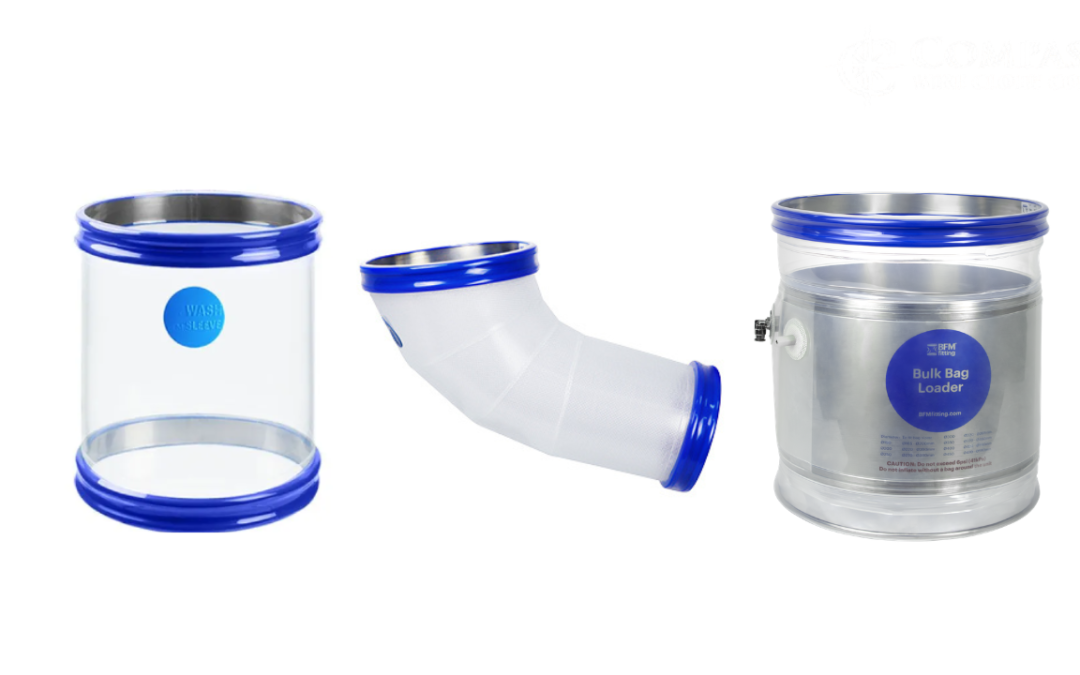
How Flexible Connectors Are Transforming Industrial Screening
Across manufacturing processes where reliability and product quality come first, seemingly minor components can make all the difference. This is especially true of connectors, the often-overlooked links between pieces of screening and conveying equipment where materials pass from one stage of processing to another. For decades, hose and clamp connectors have been the industry standard, but their limitations are increasingly at odds with modern operational expectations. As manufacturing evolves toward stricter hygiene requirements, faster production cycles, and more stringent safety standards, many facilities are discovering that outdated connector technology is quietly costing them time, money, and performance. Flexible, leak-proof BFM® connectors are reshaping the landscape, offering sealed, snap-in designs that transform how plants manage efficiency, maintenance, and risk.
Key Article Takeaways
-
Flexible BFM® Connectors: Designed to replace traditional hose-and-clamp fittings, providing a 100% leak-proof snap-in seal between screening and conveying equipment.
-
Operational & Safety Risks: Prevents costly product waste, dust explosion hazards from fine powders, and batch contamination across regulated industries.
-
Technical Superiority: Features tool-less installation in under a minute, transparent materials for real-time flow visibility, and static-dissipative polyurethane construction with ATEX certification.
-
Enhanced Durability & Hygiene: Outlasts standard fittings up to 50 times longer, eliminates bacterial growth crevices, and supports Clean-in-Place (CIP) systems.
-
Target Industries: Applied widely across food processing, pharmaceuticals, chemical manufacturing, aggregates, sand, and gravel operations.
The Cost of Leakage: Hidden Risks That Undermine Operations
Leaks in a screening or conveying system can have an impact that ripples through every layer of production. The most immediate consequence is product loss. Every particle that escapes represents lost revenue, and in sectors like pharmaceuticals, specialty chemicals, or food processing, that loss can quickly become substantial. Beyond material waste, leaks contribute to extended cleaning and unplanned downtime. Time spent shutting down lines, clearing contamination, and restarting equipment erodes productivity and can disrupt tightly coordinated production schedules.
The safety implications are even more serious. Many materials processed in industrial facilities, especially fine powders, are combustible under the right conditions. Dust escaping from poorly sealed joints can accumulate and create an explosion risk, endangering personnel and damaging equipment. Contamination is another concern. Leaks allow unwanted particles into the product stream, jeopardizing batch quality and increasing the risk of regulatory violations. Even if contamination does not occur, the presence of residue around a connector can violate hygiene standards, particularly in industries governed by strict quality assurance protocols. In this context, the integrity of a connector is not a small detail, it is a frontline defense against operational, safety, and compliance risks.
Why Traditional Solutions Fall Behind Modern Demands
Despite these stakes, many facilities still rely on traditional hose and clamp connectors and pay the price in inefficiency. These connectors often require manual cutting from rolls, resulting in inconsistent sizing and imperfect fits. That variability can lead to leaks at the point of connection and complicate inventory management, as operators must stock a range of sizes and configurations to accommodate different applications. Installing or removing these connectors is typically a tool-dependent process, lengthening changeover times and making regular maintenance more cumbersome than it needs to be.
Traditional connectors also introduce their own set of wear and tear issues. Clamps that are overtightened during installation can cut into the connector material, causing premature degradation and increasing replacement frequency. They are also prone to product buildup at the edges, creating sanitation challenges and adding to cleaning labor. For plants seeking to operate at peak efficiency, these drawbacks accumulate into real costs: more frequent downtime, higher maintenance demands, and less predictable production schedules. As processing demands grow more complex and safety regulations tighten, the industry’s reliance on these legacy designs is increasingly unsustainable.
A Better Seal: The Rise of Flexible, Leak-Proof BFM® Connectors
Next-generation flexible BFM connectors address these shortcomings by fundamentally rethinking how sealing is achieved. Instead of relying on clamps, these solutions feature a patented snap-in design that delivers a consistent, 100% sealed connection every time with no tools, guesswork, or risk of overtightening. This uniform fit dramatically reduces the likelihood of leaks and eliminates the product buildup that can occur around traditional clamps. The result is not just a cleaner connection, but a more stable process overall.
Safety is also built into the design. Many advanced BFM connectors incorporate static-dissipative compounds directly into their polyurethane construction, mitigating the risk of electrostatic discharge, a critical feature in facilities handling combustible powders. These materials often carry ATEX certification, further reducing the risk of ignition and ensuring compliance with international safety standards. The transparent construction of many BFM connectors introduces yet another operational advantage: it allows operators to visually confirm material flow, identify potential blockages, and monitor product behavior in real time without disassembling the system. By integrating safety, visibility, and reliability into a single component, these connectors do far more than prevent leaks, they actively enhance process control.
The advantages extend to maintenance and changeover as well. Because BFM connectors can be removed and reinstalled in under a minute, changeovers become faster and less labor-intensive, supporting agile production schedules and minimizing downtime. Cleaning is similarly streamlined. Many designs are fully removable for offline cleaning, and some are compatible with clean-in-place (CIP) systems, a key benefit in food, chemical, and pharmaceutical facilities where sanitation is tightly regulated. The ease of removal also reduces the need for specialized training or tools, lowering labor costs and making maintenance safer and more efficient.
In many facilities, operators appreciate the ability to quickly remove the connector and wash it thoroughly before snapping it back into place. This process helps maintain hygiene standards and extends component lifespan. For processes that rely on automated sanitation, certain designs also offer CIP-dedicated connector options designed for seamless integration into clean-in-place cycles.
Durability, Compliance, and Long-Term Performance
While sealing and safety are critical, the material science behind flexible connectors also delivers long term value. Polyurethane and other high performance materials used in these systems offer significantly longer lifespans than standard hose-and-clamp connectors. In some production settings, these BFM connectors have lasted for years—up to 50 times longer than traditional hose-and-clamp options—without needing replacement, yielding measurable savings in both parts and maintenance labor. This extended durability lowers maintenance costs and minimizes unexpected failures that can interrupt production.
The 100% sealed design has important hygiene implications as well. By keeping the product fully contained within the system, these connectors eliminate the gaps and crevices where residues can accumulate, a common source of contamination and bacterial growth. This not only simplifies cleaning but also helps facilities maintain compliance with strict international health and safety standards. All high-quality BFM connectors are independently tested to meet these requirements, giving operators confidence that their systems are performing safely and legally.
Selecting the right connector for a given application is a critical part of achieving these benefits. Engineers should begin with a thorough assessment of process requirements, using the STAMPED method—size, temperature, application, media, pressure, ends, and delivery—to identify the ideal material and configuration. This framework guides an in-depth dialogue between engineering teams and plant operators, ensuring each installation is customized for safety, efficiency, and application integrity.
Such specification work ensures compatibility with the specific demands of the process, including temperature extremes, chemical interactions, and mechanical stresses. While standardized flexible fittings offer broad compatibility, other materials (such as neoprene, EPDM, or corrugated rubber boots) may be recommended in chemical or high-abrasion environments where specialized resistance or nonstandard sizing is required, helping engineers match connector composition to the unique chemical and mechanical profile of each process. By addressing these variables proactively, plants can avoid premature wear, optimize performance, and maximize the return on their investment in new connector technology.
Companies that specialize in screening and filtration equipment understand that even small components can make or break a system’s performance. Compass Wire Cloth, a leading North American manufacturer known for its expertise in industrial separation and process systems, applies the same precision and reliability standards to the flexible connectors used in those applications.
The flexible BFM connectors featured in these systems are supplied through Compass’s long-standing partnership with Siftex, a leading distributor of custom BFM fittings and hygienic connector systems. Through this collaboration, Compass helps customers specify and integrate the right connector solution for their exact process environment, drawing on Siftex’s deep experience in connector design, material compatibility, and hygienic processing standards to ensure every installation aligns with stringent safety and cleanliness expectations.
Selecting the optimal connector is rarely a one-size-fits-all process; it requires engineering insight and close collaboration between plant teams and equipment specialists. By pairing deep technical expertise with a commitment to reliability and regulatory compliance, Compass helps customers design systems that run cleaner, safer, and more efficiently from the ground up.
Optimizing Processes Across Industries
The benefits of flexible, leak-proof BFM connectors reach their full potential in environments where precision and control are non-negotiable. In sectors like food and pharmaceuticals, they play a critical role in maintaining sterile conditions and preventing contamination during product transitions. In chemical processing, they help sustain dust-free operations and reduce the likelihood of electrostatic ignition, while in aggregates, their abrasion-resistant materials deliver consistent performance under demanding conditions.
For engineers and plant managers, the journey toward greater reliability starts with a clear understanding of how and why leaks occur and with a willingness to rethink how system interfaces are designed. Beyond product supply, engineering partners who guide customers through leak-prevention analyses and specification support serve as trusted advisors in improving plant reliability and safety. Replacing outdated, failure-prone connectors with advanced snap-in alternatives does not just solve a sealing problem; it streamlines maintenance, improves uptime, and enhances worker safety.
Ultimately, re-engineering this single connection point has ripple effects that extend far beyond the joint itself. It transforms how equipment performs, how facilities operate, and how confidently teams can meet evolving regulatory and production demands. In a competitive industrial landscape, the smallest components often make the biggest difference, and flexible connectors are proving that a more reliable, resilient process begins at the point where materials meet movement.
About the Authors
David Gentilini, Chief Sales Officer and VP of Business Development, Compass Wire Cloth in collaboration with Siftex Equipment Company, featuring Marianne Croce and Isabella Rizzo.
Frequently Asked Questions (FAQ)
What makes snap-in flexible connectors better than standard hose-and-clamp systems?
Standard hose-and-clamp fittings often require manual cutting, cause uneven sealing pressure, and are easily damaged by overtightening. Snap-in BFM® connectors use internal steel rings that fit into specialized spigots, creating a uniform 100% seal without tools or guesswork.
How do these connectors reduce safety risks in processing plants?
Escaping powder dust creates significant fire and explosion hazards. Flexible connectors prevent dust leaks and incorporate static-dissipative polyurethane with ATEX certification to dissipate static charges, reducing electrostatic discharge risks.
Can flexible connectors be used with Clean-in-Place (CIP) systems?
Yes. Many flexible connector configurations are designed for seamless integration into Clean-in-Place (CIP) cycles, making them ideal for hygienic applications in food and pharmaceutical processing.
How long do flexible connectors last compared to traditional connectors?
Made from durable, high-performance polyurethane, these flexible connectors can last up to 50 times longer than traditional hose-and-clamp options in demanding industrial environments.