
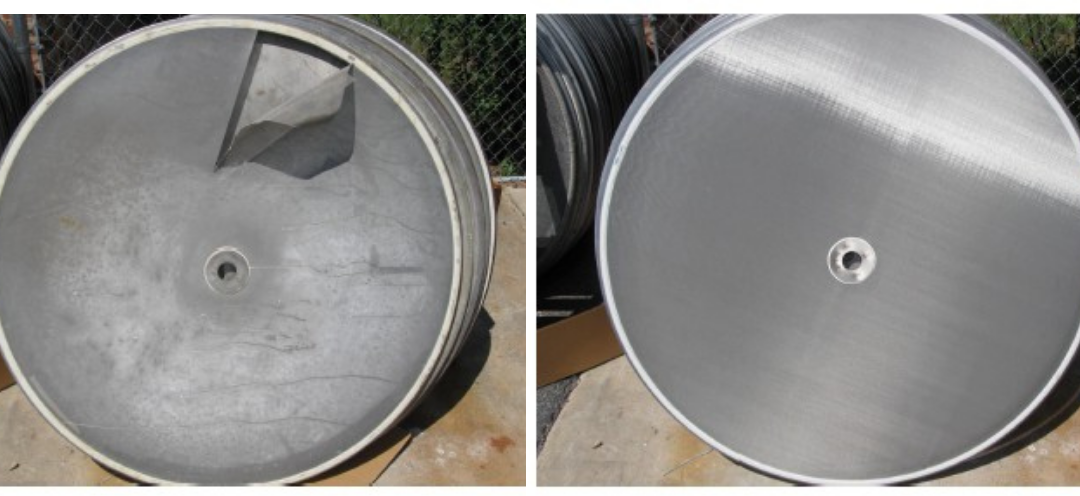
A practical way for processors to reduce screen costs, extend service life, and support sustainability goals.
Wayne Hoffman, Regional Branch Manager, Compass Wire, Southeast
In this difficult business environment, processors are looking for ways to improve efficiency and protect profitability without sacrificing quality and customer service. As day-to-day operational issues take priority, some of the seemingly less important practices fall by the wayside or are overlooked.
At the same time, manufacturers are increasingly expected to demonstrate responsible environmental practices, including reducing waste sent to landfills and supporting recycling initiatives. Re-screening round separator screens offers a practical way to support sustainability goals, control production costs, and extend the useful life of existing screening assets.
Why Re-screen Instead of Discard?
There are hundreds of thousands of round separator screens in use today and at least a million worldwide. Most throwaway units are made of materials that are not biodegradable or recyclable.
By returning torn or out-of-spec screens to the manufacturer to be reconditioned, processors can significantly reduce the number of screens being sent to landfills. Re-screening turns an otherwise unusable screen into one that looks and performs like new, but at a fraction of the cost of a completely new assembly.
How the Re-screening Process Works
Instead of sending used screens out as waste, processors can send them back to manufacturers like Compass Wire Cloth, a leading manufacturer of separation, sifting, and screening solutions, for re-screening. Manufacturers remove the old mesh and epoxy, clean and polish the ring, stretch new quality stainless steel or synthetic mesh to the customer’s specifications, and re-apply the epoxy. Because the customer already owns the ring, re-screening typically saves approximately 20–30% compared to the cost of purchasing a new screen.
The manufacturer evaluates each ring to determine whether it is suitable for re-use, since screen rings have a finite life cycle. In some cases, rings have been successfully re-screened as many as 18 times before they wear through and can no longer be used. Once a ring reaches the end of its service life, it can still be recycled into new stainless steel, further supporting waste-reduction initiatives.
Managing Freight and Logistics
Freight costs are a factor in any re-screening program, but they can be managed effectively with proper planning. Shipping multiple rings at one time can significantly improve freight economics because many less-than-truckload (LTL) carriers apply minimum shipment charges. For example, a processor may be able to ship 15 rings for approximately the same freight cost as shipping only two.
Compass offers customers the option of shipping back rings in bulk. Upon arrival, they are cleaned, inspected, and then segregated to the customer’s assigned area until they are ready for re-screening. This method also improves turnaround times. A successful re-screening program depends on a trustworthy screen supplier who will accurately determine which rings are reusable and which must be retired.
Compatibility Across Major Separator Brands
Most U.S. manufacturers of round separators and screens base screen ring size to accommodate all major brands. Simply put, a ring from Midwestern can fit in a Sweco unit, a Sweco ring will fit in a Kason unit, and so on. Processors should confirm ring compatibility with their screen supplier before shipping a large number of used screens for re-screening, to avoid exceptions that may not be suitable.
Operational and Environmental Benefits
A structured re-screening program for round separator screens allows processors to reduce waste sent to landfills, lower screen replacement costs, and extend the service life of screen rings. By integrating re-screening into standard maintenance practices, processors can support environmental stewardship while also improving cost control and equipment utilization.