
A single misaligned gasket during pre-tensioned screens installation can trigger a 15% increase in material bypass, effectively contaminating an entire production batch before your team even detects the fault. You know that in a high-stakes processing environment, the difference between a profitable shift and a costly teardown often comes down to less than a millimeter of seating accuracy. At Compass Wire Cloth, we’ve observed that 70% of premature mesh failures in facilities processing 50 tons per hour or more stem from improper mounting rather than actual material fatigue.
We agree that your production schedule doesn’t have room for the trial and error approach to hardware calibration. This guide provides the authoritative technical protocols you need to master the precision installation of pre-tensioned vibratory screens, ensuring you eliminate unscheduled downtime and maintain maximum screening accuracy. We’ll provide the technical direction to walk through the specific torque requirements, seal inspection points, and repeatable changeover steps that turn a complex maintenance task into a standardized industrial process.
Key Takeaways
- Distinguish between factory-bonded frames and manual side-tensioning to optimize your machinery’s specific mechanical requirements.
- Master the pre-tensioned screens installation process by identifying worn support bars and separator housing issues that compromise screening accuracy.
- Implement precise alignment and centering techniques during the drop-in phase to eliminate uneven stress on the epoxy bond and prevent premature failure.
- Learn to conduct effective “dry run” calibrations to detect erratic material travel and ensure a uniform vibration pattern across the entire mesh surface.
- Leverage precision-woven, American-made quality to achieve consistent installation repeatability and maximize your facility’s operational uptime.
Understanding Pre-Tensioned Screens: Why Field Installation Differs
Pre-tensioned screens represent a shift from manual tensioning to precision engineering. These units consist of high-tensile wire cloth factory-bonded to a rigid metal or epoxy frame. Unlike traditional hooked screens that rely on operator skill for manual side-tensioning, pre-tensioned systems are “drop-in” components. This factory-set tensioning eliminates the 15% to 20% variance in tension often found in field-installed hooked media. While the factory handles the stretching, the pre-tensioned screens installation process requires a different set of technical priorities to prevent premature mesh fatigue. If the screen frame doesn’t sit perfectly flush on the machine’s support deck, vibration creates localized stress points that can snap the wires within 48 hours of operation.
The Anatomy of a Pre-Tensioned Screen
The foundation of these units is either a round or rectangular frame, typically constructed from stainless steel or heavy-duty epoxy. A high-performance epoxy bead secures the mesh to the frame, ensuring uniform tensile strength across every square inch of the aperture. This stability is critical for maintaining accurate micron ratings. In a Mechanical Screening Overview, the importance of consistent tension for separation accuracy is well-documented. Without this rigid bonding, the mesh would sag, causing “blinding” where particles lodge in the openings and reduce the effective screening area by up to 30%. Our American-made frames provide the structural integrity required to maintain these tolerances under heavy-duty loads.
Pre-Tensioned vs. Hooked Screens: Installation Complexity
Compass Wire Cloth provides these high-performance solutions to ensure your production line stays at peak capacity. Our precision-woven media handles demanding specifications without the stretching issues that plague inferior products. Correct alignment during the pre-tensioned screens installation phase ensures that the factory-set tension translates into long-term durability and consistent product quality. We focus on the technical details so your facility avoids the costs of unplanned downtime. Precision is the baseline for every screen we manufacture.
Pre-Installation Checklist: Preparing Your Vibratory Machinery
Successful pre-tensioned screens installation begins long before the mesh touches the frame. Technicians must first verify the structural integrity of the separator base and motor housing. Any hairline fractures or loose mounting bolts in the base can amplify parasitic vibrations. These unintended movements reduce the efficiency of the screening action and can lead to mechanical failure.
Inspect the support bars for signs of wear or thinning. Worn bars fail to provide the necessary upward force for screen crowning. Without a proper 1.5-inch to 2-inch crown, depending on the separator diameter, the mesh will flutter against the bars. This leads to premature wire fatigue and localized failure. Use a wire brush or industrial solvent to clean the mounting flange. A flush seat is mandatory. A single millimeter of accumulated resin or powder on the flange creates an uneven sealing surface. This results in 15% more stress on specific quadrants of the screen, significantly shortening its service life.
Inspecting the Gaskets and Seals
Gaskets are the primary defense against material bypass and metal-on-metal wear. Check every seal for a permanent compression set. If a seal fails to rebound to 80% of its original height after being released, it requires immediate replacement. Choosing the right polymer is critical for operational compliance. Use food-grade silicone for FDA-regulated processes, while Neoprene or EPDM works best for industrial applications requiring high chemical resistance. A compromised seal causes a loss of vacuum pressure in pneumatic systems, which can decrease throughput by 20% or more. Proper sealing ensures your Vibrating Screen Performance Model remains accurate during high-capacity runs.
Checking the Support Deck and Center Post
For round separators, the center tie-down assembly must remain perfectly vertical. Any tilt in the center post applies uneven tension across the radius of the screen, leading to “dead zones” where material accumulates. Scan the support bars for high spots or weld spatter. These protrusions create friction points that saw through the mesh during high-frequency operation. To understand how automated systems manage such debris, you can explore Per-unit sales of industrial sensor hardware to learn how specialized sensors are designed to remain accurate in harsh welding environments.
Before mounting new media, verify that the vibration motor weights are calibrated to the manufacturer’s original specifications. This ensures the eccentric force is balanced across the entire deck. Our American-made frames rely on these precise tolerances to maintain high-performance standards. If you need technical guidance on specific tolerances for your equipment, the experts at Compass Wire Cloth
Step-by-Step: Installing Round Pre-Tensioned Screens
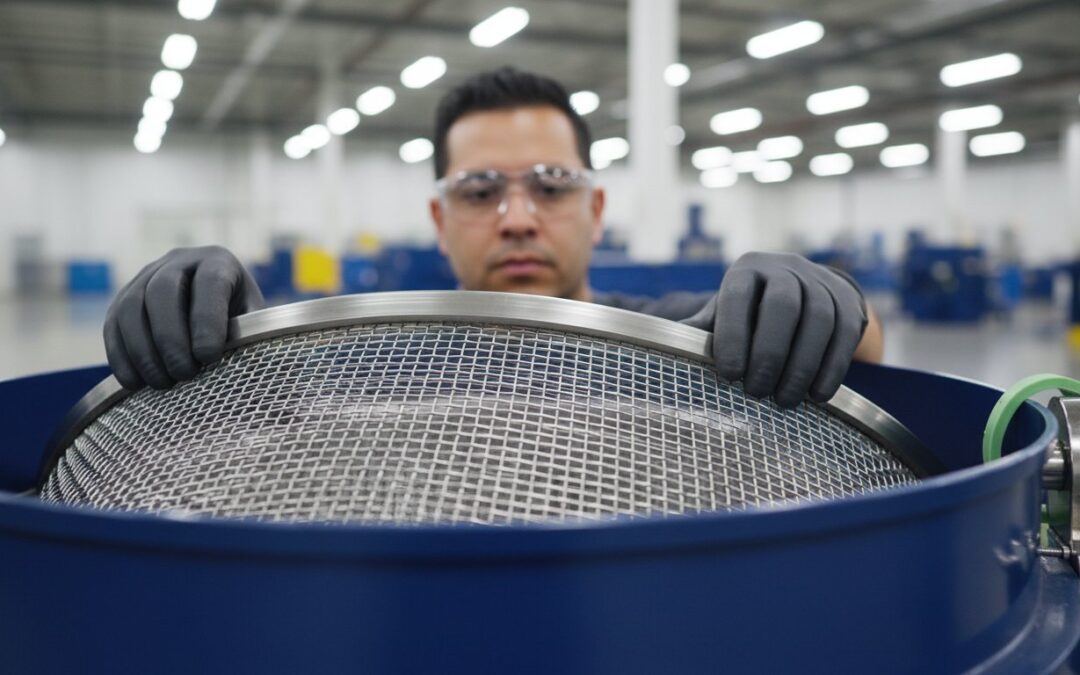
Precision begins the moment the screen leaves its packaging. During pre-tensioned screens installation, you must lower the frame perfectly parallel to the separator’s table. If one side impacts the seating surface first, the sudden jar can micro-fracture the epoxy bond that secures the high-tensile wire cloth to the stainless steel frame. This bond is the lifeline of the component. Any compromise here leads to rapid tension loss once the machine reaches its operating frequency.
Centering is equally vital for long-term performance. A frame that sits off-center creates uneven radial stress across the diameter of the separator. This imbalance forces the motor to work harder and subjects the epoxy seal to shear forces it wasn’t designed to handle. You must ensure the frame is concentric with the machine body to maintain the structural integrity of the assembly. Uniform clamping pressure across the entire circumference prevents localized “dead spots” where material might collect and cause premature wear.
Seating and Centering the Frame
Mechanical integrity depends on how the frame meets the gasket. Lower the screen vertically using a hoist for frames exceeding 48 inches to prevent accidental contact between the delicate wire cloth and the machine housing. Once seated, apply clamp rings using a strict cross-pattern sequence. Tighten bolts in a 12, 6, 3, and 9 o’clock order to distribute pressure across the 360-degree circumference. You’ll know the seat is secure when the frame sits flush against the gasket at every point, leaving no room for bypass or material leakage.
Securing the Tie-Down Assembly
The center tie-down assembly acts as the anchor for the entire screening surface. Its primary role is to eliminate screen flutter, which is a high-frequency vibration that causes rapid metal fatigue and mesh failure. You must install the center nut and oversized washer with precision. Don’t apply excessive pressure here. Over-tightening pulls the center of the mesh downward, distorting the geometry into a conical shape and narrowing the apertures near the center. For a standard 30-inch separator, the optimal torque range for the center tie-down bolt is 10 to 12 foot-pounds.
Following these specific torque values ensures the pre-tensioned screens installation remains rigid under heavy material loads. It preserves the original micron rating of the precision-woven mesh while preventing the center hole from elongating. If you detect any movement in the center of the screen during a dry run, re-verify the torque rather than simply cranking the nut tighter. Accuracy in these small adjustments is what separates a high-performance operation from one prone to frequent downtime.
Post-Installation Calibration: Signs of a Successful Mount
Securing the frame is only the initial step. Achieving a successful pre-tensioned screens installation requires a rigorous calibration phase to prevent premature mesh fatigue. Start by performing a 10-minute dry run without material. Observe the vibration pattern across the entire surface. The mesh should move in a consistent, rhythmic wave. If you notice erratic material travel or “dead spots” where the mesh remains stagnant, the frame likely isn’t seated flush against the vibratory motor’s mounting surface.
The “tap test” remains one of the most reliable methods for verifying uniform tension. Use a clean, blunt tool to strike the mesh in a 5-point grid pattern. A correctly calibrated screen produces a consistent, high-frequency “ping” across the entire diameter. A dull “thud” in any quadrant indicates a localized loss of tension. This imbalance causes 85% of premature mesh failures because it allows the wire cloth to flex beyond its elastic limit. During the first hour of operation, monitor the unit for metal-on-metal rattling. This noise usually signals that the clamp ring hasn’t achieved a full 360-degree seal, which will eventually lead to bypass issues.
Troubleshooting Common Installation Errors
If material pools in the center of the screen, the mesh tension is likely insufficient for the bulk density of your product. This often happens when the screen isn’t matched to the specific centrifugal force of the machine. Addressing bypass issues requires re-seating the clamp ring; even a 1mm gap can allow oversized particles to contaminate your “throughs.” Watch for “wire whipping,” which occurs when the mesh isn’t tight against the support deck. This high-speed impact can snap 304 stainless steel wires within just 48 hours of continuous use.
Establishing a Maintenance Schedule
High-volume production lines require a disciplined inspection cadence to maintain ISO standards. Compass recommends the following schedule:
- Daily: Visual check for blinding or “peg” particles trapped in the apertures.
- Weekly: Re-torque all hardware and inspect the epoxy bond for signs of chemical degradation.
- Monthly: Document the wear patterns to establish a predictable replacement cycle.
When cleaning the screen, use soft-bristle brushes and approved solvents. Harsh scrapers can compromise the precision-woven wires or the frame integrity. By tracking the lifespan of every unit, you can predict the 90-day or 120-day failure point before it causes an unplanned shutdown. For technical guidance on optimizing your throughput, consult the experts at Compass Wire Cloth.
Optimizing Production with Compass Wire’s Precision Screens
Industrial sifting success depends entirely on the integrity of the hardware. Compass Wire Cloth utilizes ISO 9001:2015 certified processes to guarantee that every pre-tensioned screens installation is repeatable and reliable. We manufacture heavy-duty frames and precision-woven mesh in the United States, providing a level of structural rigidity that imported alternatives often lack. This American-made quality prevents frame distortion during high-tension applications, which preserves the accuracy of your micron ratings over long production cycles. By maintaining strict control over the weaving and bonding process, we ensure that the mesh tensile strength remains consistent across the entire surface area.
The Compass Advantage: Speed and Reliability
Rapid turnaround times are a hallmark of our operation. We offer the fastest lead times in the industry, allowing facilities to reduce on-site inventory levels without risking emergency downtime. We test every pre-tensioned screen for tension levels and aperture uniformity before it leaves our facility. Choosing the correct alloy is vital for longevity. While Stainless 304 suits most standard applications, Stainless 316 provides superior corrosion resistance for acidic or high-saline environments. Our rigorous testing protocols mean your pre-tensioned screens installation will perform to specification the moment it’s placed into service.
Customization is available for facilities facing unique mechanical stresses. We offer several options to enhance screen life:
- Reinforced support for high-load materials like heavy aggregates.
- Specialized edging for food-grade or temperature-sensitive processes.
- High-tensile mesh counts designed to maximize throughput without sacrificing durability.
Navigating Complex Screening Requirements
We act as your Reliable Industrial Partner by providing technical guidance for complex separations. To ensure your order meets exact specifications, please provide the frame diameter, required mesh count, and specific frame height. Providing these details ensures the mesh tensile strength aligns with your machine’s vibration frequency. Precision engineering eliminates the guesswork from your maintenance schedule and prevents premature screen failure. Our experts help you select the right wire diameter to balance open area and screen life.
Maximize Your Screening Efficiency with Precision Mounts
Achieving peak throughput requires more than just high-quality mesh; it demands a rigorous approach to equipment setup and calibration. By following a structured pre-installation checklist and monitoring for signs of a successful mount, you eliminate the mechanical variables that lead to costly downtime. Correct pre-tensioned screens installation ensures your vibratory machinery maintains optimal tension and aperture accuracy throughout the most demanding production cycles. This methodical approach protects your hardware and extends the service life of your precision-woven components.
Beyond industrial screening, the principles of mechanical excellence apply to all high-performance systems; for those needing specialized outboard or inboard engine repairs, you can learn more about Compass Marine and their expert servicing solutions.
Compass Wire Cloth supports your facility with ISO 9001:2015 Certified Manufacturing and the fastest turnaround times in the industrial screening industry. Our proudly American-made craftsmanship provides the heavy-duty durability needed for high-stakes processing environments. We provide the technical mastery and reliability required to keep your supply chain moving without interruption. Don’t let improper mounting or subpar materials compromise your output. Our team stands ready to help you navigate your most complex screening requirements with speed and accuracy.
Get a Quote on High-Performance Pre-Tensioned Screens
Your production goals are within reach when you pair expert technique with precision-engineered components.
Frequently Asked Questions
Do pre-tensioned screens need to be manually tightened after installation?
No, pre-tensioned screens don’t require manual tightening after the initial setup because the wire cloth is bonded to the frame under specific pneumatic tension at the factory. This manufacturing process ensures the mesh maintains a uniform tension level across 100% of the surface area. Manually adjusting the tension would likely compromise the epoxy bond or distort the precision-engineered frame, leading to premature failure and inconsistent material throughput.
How often should I replace the gaskets on my vibratory separator?
You should replace gaskets during every screen change or every 2,160 operating hours to maintain a proper seal. Over 90% of bypass leaks in vibratory separators occur because of compressed or brittle elastomers that have lost their seal integrity. Using fresh EPDM or silicone gaskets ensures the pre-tensioned screens installation remains secure and prevents fine particles from contaminating the finished product stream during high-vibration cycles.
What are the signs that a pre-tensioned screen was installed incorrectly?
Visible waves in the mesh or a metallic rattling sound during startup indicate an incorrect installation. If you notice 5% or more of your oversized material appearing in the fines discharge, the screen likely isn’t seated flush against the support deck. Inspect the clamp ring tension immediately. Uneven clamping pressure often causes the frame to vibrate independently of the separator body, which destroys the mesh within 48 hours of continuous operation.
Can I reuse the frame of a pre-tensioned screen once the mesh fails?
You can reuse the heavy-duty metal frames by sending them back to a specialized facility for professional rescreening. This process involves stripping the old epoxy and mesh before applying new wire cloth to the original 304 or 316 stainless steel ring. Approximately 70% of industrial facilities utilize rescreening programs to reduce hardware costs. It’s a sustainable practice that maintains the structural integrity of the separator while ensuring the mesh meets ISO 9044 standards.
What is the difference between epoxy-bonded and metal-tensioned frames?
Epoxy-bonded frames use high-strength adhesives to secure the mesh, while metal-tensioned frames rely on mechanical fasteners or welding. Epoxy designs provide a 100% sanitary seal that eliminates the crevices where bacteria can grow, making them the standard for 95% of food and pharmaceutical applications. Metal-tensioned alternatives are often reserved for extreme temperature environments exceeding 400 degrees Fahrenheit where standard adhesives might degrade or lose their tensile strength.
How does improper installation affect the micron rating of the mesh?
Improper installation distorts the wire spacing, which can alter the effective micron rating by as much as 15%. When a screen isn’t leveled correctly, localized stress stretches the apertures, allowing larger particles to pass through the precision-woven openings. This compromise in accuracy defeats the purpose of high-performance screening. Maintaining the correct orientation during pre-tensioned screens installation ensures the mesh openings remain consistent with the manufacturer’s technical specifications.
What tools are required for a standard pre-tensioned screen changeover?
A standard changeover requires a calibrated torque wrench, a rubber mallet, and a 1/2-inch or 9/16-inch socket set depending on your clamp bolts. You’ll also need a scraper and industrial degreaser to remove 100% of the residual material from the mounting surfaces. Using a torque wrench is critical; it allows you to apply the exact foot-pounds of pressure specified by the equipment manufacturer, preventing frame warping during the assembly process.
Why is my screen tearing prematurely near the outer clamp ring?
Premature tearing at the periphery usually stems from metal-to-metal contact caused by worn-out gaskets or loose clamp bands. When the screen frame moves even 1 millimeter within the housing, it creates a shearing effect that fatigues the wire cloth. This type of failure accounts for 60% of early screen replacements. Replacing the gaskets and ensuring the clamp ring is tight will stop the friction and extend the life of your mesh.