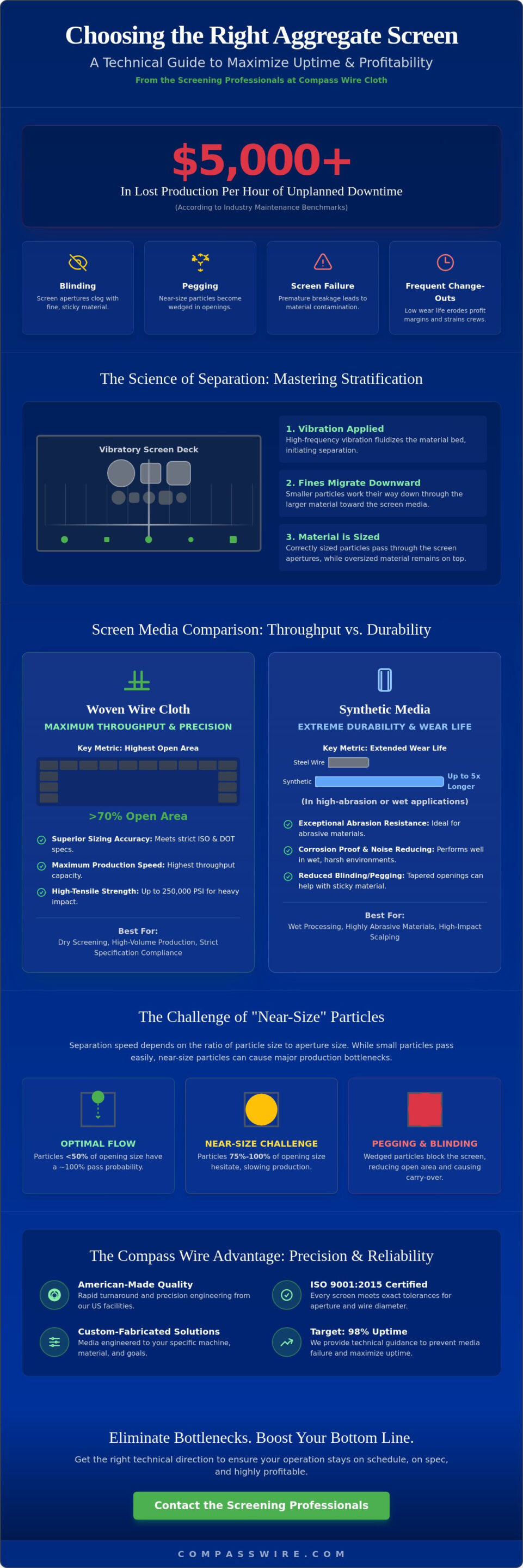
A single hour of unplanned downtime in a high-volume quarry can cost an operator over $5,000 in lost production according to industry maintenance benchmarks. While many facilities focus on crusher settings, the choice of aggregate screen types often dictates whether you meet your daily tonnage or fall behind due to blinding. You understand that maintaining 100% compliance with ISO or DOT specs isn’t optional; it’s a requirement for every load that leaves your site. Frequent screen failures and material pegging don’t just slow you down; they erode your profit margins and strain your maintenance crews.
Compass Wire Cloth provides the technical mastery needed to eliminate these bottlenecks through precision engineering and American-made quality. This guide provides the data you need to choose between high-tensile wire cloth and synthetic media to reduce your change-out frequency. We’ll compare aperture precision, tensile strength, and throughput capacity so you can select the heavy-duty media that lasts longer under abrasive loads. Discover how the right technical direction ensures your operation stays on schedule and fully compliant.
Key Takeaways
- Learn how to master stratification by aligning your vibratory screener’s motion with the correct media to maximize throughput and material separation.
- Evaluate the performance differences between various aggregate screen types, comparing the versatility of precision-woven wire cloth against the durability of polyurethane and rubber.
- Determine how specific machine configurations, including stroke and frequency, dictate your screen tension requirements and long-term mechanical reliability.
- Identify the critical selection factors, such as abrasive index and aperture shape, to optimize sorting accuracy while minimizing industrial downtime.
- Discover how American-made, custom-fabricated solutions provide the rapid turnaround and precision engineering necessary to maintain high-stakes production cycles.
The Role of Aggregate Screen Types in Industrial Efficiency
Industrial efficiency in material processing isn’t a matter of chance; it’s a result of precise mechanical separation. Aggregate screening is the process of dividing raw materials into specific particle sizes to meet strict engineering requirements. This separation relies heavily on the concept of stratification. As high-frequency vibration is applied to the deck, the material bed fluidizes. This movement forces smaller particles to migrate downward toward the aggregate screen types, while larger, oversized rocks remain at the top of the bed. When this process is interrupted by poor media choice, the entire production line suffers.
Compass Wire Cloth understands that the financial stakes of screen selection are high. Utilizing the wrong media leads to “out-of-spec” material, which often results in heavy financial penalties from contractors or the complete rejection of a 20-ton load. In high-volume operations, even a 3% increase in contamination within a clean stone pile can erase the day’s profit margins. We focus our engineering on three critical pillars: precision in aperture sizing, maximum throughput for high-speed processing, and extended wear life to minimize costly downtime. Understanding the nuances of different aggregate screen types is the only way to maintain a competitive edge in the modern quarry or recycling facility.
Separation Probability and Particle Dynamics
Separation speed is largely dictated by the ratio of the particle size to the aperture size. When a particle is less than 50% of the opening size, the probability of it passing through the screen is nearly 100%. The technical challenge arises with “near-size” particles, which are typically between 75% and 100% of the aperture diameter. These particles tend to hesitate at the opening or become wedged, a condition known as pegging. This blockage reduces the available screening surface and forces material to carry over into the wrong pile. Effective open area is the ratio of the total area of the apertures to the total area of the screen surface, and it serves as the primary driver of your total production volume.
The Consequences of Incorrect Screen Selection
Choosing an inadequate screen wire leads to premature breakage, particularly in high-impact applications where heavy-duty tensile strength is required. When a wire fails, the resulting hole allows oversized material to bypass the screen, contaminating the fines and necessitating a full production halt for repairs. This improper selection also causes “carry-over,” where valuable fine material remains trapped in the coarse pile, effectively wasting processed product.
To prevent these inconsistencies, we manufacture our media under strict ISO 9001:2015 standards. This certification ensures that every precision-woven cloth we ship from our American facilities meets exact tolerances for aperture and wire diameter. We provide the technical guidance needed to achieve a 98% uptime rating, ensuring that your production schedule remains uninterrupted by preventable media failure. Our rapid turnaround times mean you don’t have to wait weeks for the high-performance media your operation requires today.
Comparing Screen Media: Woven Wire Cloth vs. Synthetic Mesh
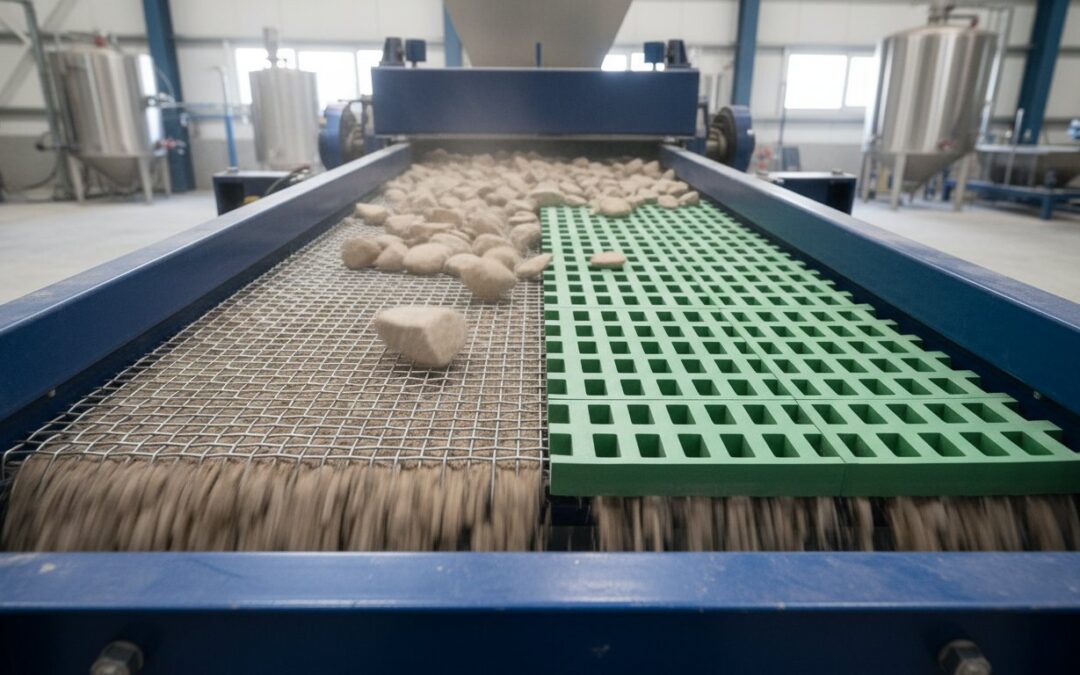
Selecting the correct media between woven wire and synthetic options is a critical decision that dictates production efficiency and your total cost-per-ton. Woven wire cloth remains the industry benchmark for most aggregate screen types because it provides the highest open area, often exceeding 70% in standard configurations. This maximum transparency allows for higher throughput and faster material travel. However, synthetic options like polyurethane and rubber serve specific roles in high-abrasion or wet processing environments where wire would suffer from premature fatigue.
High-carbon steel provides the extreme tensile strength required for heavy impact, typically ranging from 180,000 to 250,000 PSI. While stainless steel alloys offer slightly lower tensile strength, they’re necessary when processing corrosive materials or ores with high moisture content. The fundamental trade-off involves the longevity of synthetics versus the screening precision of wire cloth. A synthetic panel might last 5 times longer than steel in a wet application, but it cannot match the aperture accuracy or the high open area of a precision-woven wire screen. If you’re struggling with frequent replacements, you can find the right technical direction by evaluating your specific material abrasive index.
High-Tensile Woven Wire Specifications
High-tensile, oil-tempered wire is the preferred specification for high-impact aggregate loads. This wire undergoes a specialized heat-treatment process that significantly increases its resistance to abrasion and vibration-induced fatigue. Double-crimp weaves provide excellent aperture stability for smaller openings, ensuring consistent product sizing. For apertures exceeding 1 inch, lock-crimp weaves are superior; they utilize pre-bent wires to prevent shifting under heavy loads. Operators should switch from high-carbon to stainless steel when the material pH drops below 6.0 or when moisture levels exceed 15% to prevent blinding caused by surface oxidation.
Synthetic Media: Polyurethane and Rubber
Synthetic media solves specific environmental and maintenance challenges. Rubber screens are indispensable for urban quarries where noise ordinances are strictly enforced. These screens can reduce ambient noise levels by as much as 9 decibels compared to steel. Polyurethane modular panels improve maintenance safety because they’re lightweight and easier for a single technician to replace. These materials also possess “self-cleaning” properties. The inherent elasticity of the polymer allows the surface to flex under the weight of the load, which effectively ejects sticky fines that would otherwise cause blinding or pegging in rigid wire apertures.
Mechanical Configurations: How Machine Motion Dictates Screen Type
The mechanical action of a vibrating screen directly influences the selection of aggregate screen types and their subsequent performance. Circular, linear, or elliptical motions create distinct physical stresses on the wire cloth. Operators must match the screen media to these specific forces to prevent premature fatigue or blinding. The interaction between machine G-force and the wire’s tensile strength determines whether a screen lasts for weeks or fails in days. High-frequency machines demand higher tensioning precision to prevent the cloth from fluttering against the support bars, which causes rapid destruction.
Inclined vs. Horizontal Screening Dynamics
Inclined screens operate at angles between 15 and 30 degrees. They rely on gravity to move material, which permits higher travel speeds of 60 to 100 feet per minute. This allows for a thinner material bed, facilitating faster stratification where smaller particles reach the screen surface quickly. Because gravity does the heavy lifting, these machines often use lower vibration amplitudes. This environment is ideal for standard woven wire with traditional hook strips, provided the wire diameter is sufficient to handle the initial impact of the feed.
Horizontal screens require more aggressive linear motion to propel material. These units typically operate at 3-g to 5-g of acceleration to keep the bed fluid. Engineers often specify heavier wire gauges for these decks to withstand the increased stroke and frequency. Without the proper wire diameter, the constant impact and high-frequency vibration will cause the metal to reach its elastic limit, leading to immediate breakage. Selecting the right wire alloy is essential for these high-stress environments to ensure the media doesn’t stretch or sag during operation.
Tensioning Systems and Edge Preparations
Secure installation is the primary defense against screen failure. Tensioning systems vary based on the machine’s design, typically categorized as side-tensioned or end-tensioned. Side-tensioned decks are standard in most aggregate plants. They require precision-formed hook strips, or shrouds, to distribute tension across the entire surface. If a hook isn’t perfectly parallel to the screen edge, the media will whip, causing metal fatigue within a single shift. Tension must be checked after the first four hours of operation to account for initial wire seating and prevent loosening.
Compass Wire Cloth manufactures custom hook profiles, including C-style, U-style, and welded reinforced edges, to eliminate high-stress points. We provide precision-woven solutions that handle the unique torque of heavy-duty vibratory screeners. For machines using pre-tensioned frames, we bond the wire cloth to rigid borders to eliminate field adjustments. This level of craftsmanship ensures the aggregate screen types you select maintain their aperture integrity under maximum load. Our rapid turnaround ensures your facility stays operational without compromising on technical specifications or American-made quality.
Critical Selection Factors for High-Performance Screening
Selecting the right aggregate screen types requires a precise balance of metallurgy and geometry. You must evaluate the Abrasive Index of your feed material before committing to a specification. While the wire itself must be durable, the heavy-duty machinery housing these screens often requires high-quality iron castings, such as those manufactured by Bowmanville Foundry, to maintain structural integrity under constant load. For instance, granite often contains up to 72% silica. This demands high-tensile oil-tempered wire or specialized polymers to prevent premature thinning. Limestone is significantly less aggressive, which often allows for standard hard-drawn carbon steel.
Beyond material hardness, focus on your Total Cost of Ownership (TCO). Avoid the trap of prioritizing the lowest initial purchase price. A screen that costs 20% more but offers a 50% longer wear life significantly reduces your cost-per-ton. This approach minimizes the frequency of change-outs and maximizes your plant’s uptime.
Managing Blinding and Pegging
Blinding and pegging are distinct challenges that require different technical solutions. Blinding occurs when moisture or clay creates a film over the apertures, effectively sealing the screen. Pegging happens when near-size particles wedge into the openings. To combat these issues, we recommend self-cleaning screen geometries. Ripple or wave patterns allow individual wires to vibrate independently. This movement sheds sticky material and ejects trapped rocks. In fine-mesh applications, ball trays provide a mechanical solution. These trays house specialized cleaning balls that strike the underside of the wire cloth to keep the apertures clear during operation.
Material Shape and Sizing Accuracy
Elongated or “slabby” particles often bypass standard sizing, a problem known as flaking. Rectangular mesh is the primary solution here. It provides the necessary relief for longer particles while maintaining strict width specifications. You must also account for wire diameter. As the wire wears, the effective opening of the screen increases. This gradual change can lead to out-of-spec product if not monitored. Use this checklist to verify precision before every installation:
- Confirm aperture dimensions using a digital caliper.
- Verify that the wire gauge matches the original specification to maintain open area percentages.
- Check tensioning rails for alignment to ensure even material distribution.
- Inspect the alloy grade to ensure it matches the Mohs hardness of your specific aggregate.
Custom-Fabricated Solutions: The Compass Wire Advantage
Selecting the right aggregate screen types is only half the battle. The other half is ensuring those screens are manufactured to exact specifications and delivered before a production delay turns into a financial crisis. Compass Wire Cloth functions as a technical partner rather than a simple vendor. We specialize in custom-fabricated solutions for complex, non-standard screening needs that off-the-shelf products can’t satisfy. Our team understands that every aggregate operation has unique variables, from abrasive material characteristics to specific machine tolerances. Precision matters when your throughput depends on the consistency and durability of your aggregate screen types.
The Fastest Turnaround in the Industry
Industrial downtime costs often exceed $10,000 per hour in high-volume mining and processing operations. We mitigate this risk through our domestic manufacturing model. By fabricating everything in the United States, we eliminate the 6-to-12-week lead times associated with overseas shipping and customs delays. Local production means your replacement media is on a truck in days, not months. Our facility maintains a massive inventory of wire cloth rolls in various alloys and mesh sizes, allowing for immediate fabrication of custom orders. Compass Wire provides the peace of mind that comes from precision engineering. We don’t just ship products; we deliver uptime.
Specialized Industrial Support
Our expertise extends beyond providing raw media. We produce custom cut pieces and pre-tensioned round screens designed for specific vibratory screening machinery, ensuring a perfect fit that prevents material bypass and premature wear. We support the entire screening system, offering guidance on tensioning requirements and alloy selection to maximize service life in corrosive or high-impact environments. Quality isn’t a vague promise here. Our ISO 9001:2015 certification acts as a formal guarantee of quality for high-stakes environments where material purity and sizing accuracy are critical.
We prioritize technical mastery over marketing fluff. Whether you need heavy-duty hooked screens for primary scalping or fine-mesh sieves for final grading, we provide the technical guidance to navigate complex processing requirements. Contact Compass Wire Cloth for a custom aggregate screen quote today.
Maximize Throughput with Precision-Engineered Screening Media
Selecting the ideal aggregate screen types for your operation requires a technical alignment between machine motion and material specifications. You’ve seen how high-tensile industrial alloys outperform standard mesh in high-abrasion environments. Balancing aperture precision with the durability of woven wire or synthetic mesh ensures your facility maintains peak efficiency without frequent downtime. Every minute of production depends on the integrity of your screen media and the specific mechanical configuration of your equipment; for expert maintenance of these machines, visit Ms. Hydraulics LLC.
Ready to upgrade your industrial media? Request a Quote for Custom Aggregate Screens today and secure the reliability your production line deserves.
Frequently Asked Questions
What are the most common aggregate screen types used in quarries?
High-carbon woven wire, polyurethane modules, and self-cleaning wire are the three most common aggregate screen types utilized in modern quarry operations. Woven wire accounts for approximately 70% of standard screening applications due to its high open area and cost-effectiveness. Polyurethane is preferred for wet applications or where noise reduction is required. We manufacture these precision-woven solutions in our American facility to ensure rapid turnaround for 24/7 production environments.
How do I choose between woven wire and polyurethane aggregate screens?
You should choose woven wire for high open area and maximum throughput, while polyurethane is better suited for abrasive, high-impact environments. Woven wire provides up to 85% open area for superior sizing accuracy. In contrast, polyurethane screens can last 5 to 10 times longer than standard wire in heavy-duty applications. We help you navigate these specifications to balance initial cost with total wear life per ton processed.
What causes aggregate screens to blind or peg, and how can I fix it?
Blinding occurs when moisture creates a surface film over the aperture, while pegging happens when near-size particles wedge into the openings. You can eliminate these issues by installing self-cleaning screens or increasing the vibratory frequency by 10% to 15%. Our high-performance agitated wire screens use independent wire movement to shed sticky fines. This prevents downtime and maintains a consistent flow rate across the entire screen deck.
Which wire alloy is best for screening highly abrasive materials like granite?
High-carbon oil-tempered wire is the industrial standard for screening granite and other 6 to 7 Mohs hardness materials. This alloy offers a tensile strength range of 180,000 to 230,000 PSI, providing the necessary durability for high-impact loads. For corrosive or extremely fine screening, we recommend 304 or 316 stainless steel. These alloys ensure your media maintains its aperture integrity even under the harshest abrasive conditions.
How does screen tension affect the lifespan of an aggregate screen?
Improper tensioning is responsible for 90% of premature screen failures because it allows the cloth to whip against the support bars. You must maintain uniform tension across the entire deck to prevent metal fatigue and wire breakage. We recommend checking tension bolts after the first 4 hours of operation and every 40 hours thereafter. Properly tensioned aggregate screen types last longer, which reduces your maintenance intervals and operational costs.
What is the difference between an inclined and a horizontal aggregate screen?
Inclined screens use gravity and a circular stroke at 15 to 30 degrees to move material, whereas horizontal screens rely on a linear, high-G force stroke to convey the load. Inclined units are more common in primary screening because they handle larger volumes with less power. Horizontal screens offer better sizing accuracy for finished products. Our technical experts provide the exact media specifications required for both configurations to maximize your plant’s efficiency.