A single hour of unplanned downtime in a high-volume processing plant can cost an average of $260,000 according to Aberdeen Research. Most of these losses result from preventable mechanical failures in the separation stage where standard mesh simply can’t withstand the constant G-force of a vibratory motor. You know that frequent screen failure isn’t just a maintenance task; it’s a threat to your product purity and total output. Compass Wire Cloth provides the technical mastery needed to eliminate these vulnerabilities through high-performance screen reinforcements.
In this guide, you’ll learn how specialized reinforcements extend the service life of industrial vibratory screens and prevent premature fatigue. We’ll examine the specific tensile strength requirements and alloy selections that ensure your equipment maintains its micron rating under heavy loads. We’ll detail the hardware configurations, including backing cloths and perforated plates, that reduce your maintenance frequency and maximize your production uptime with American-made reliability.
Key Takeaways
- Understand how structural additions protect wire cloth from high G-force loads and mechanical stress in vibratory machinery.
- Identify the specific applications for backing cloth and center strips to shield your mesh from premature failure during high-impact material drops.
- Evaluate the performance benefits of stainless steel and high-tensile alloys used in industrial screen reinforcements to maximize abrasion and corrosion resistance.
- Master the balance between throughput and longevity by calculating the impact of reinforcement patterns on your equipment’s total open area.
- Leverage American-made precision engineering to secure rapid turnaround times and ISO-certified reliability for your critical screening operations.
What are Industrial Screen Reinforcements and Why Do They Matter?
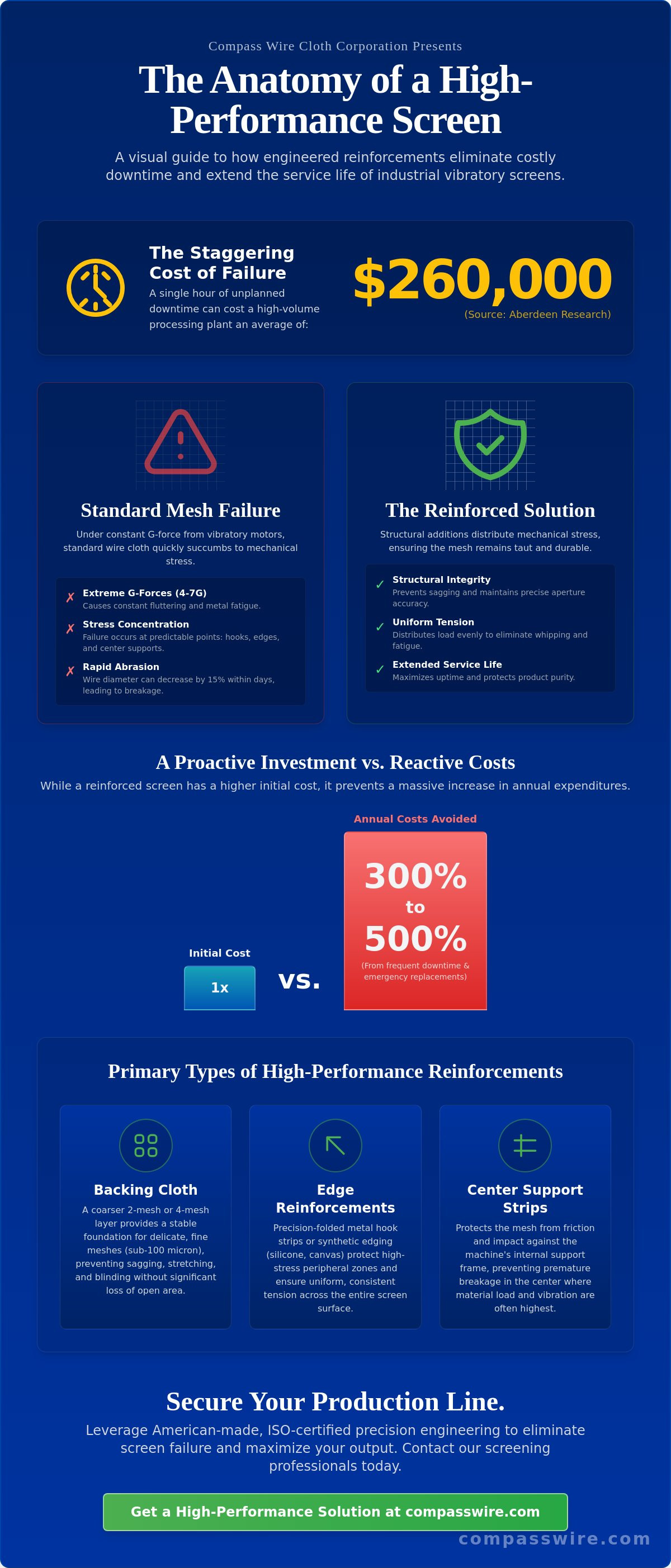
Industrial screen reinforcements are structural additions integrated into wire cloth and sifter mesh to enhance mechanical durability under extreme operating conditions. These aren’t mere accessories; they’re engineered components designed to withstand the violent accelerations common in modern mechanical screening processes. High-performance vibratory machinery often generates forces between 4G and 7G. Without proper screen reinforcements, standard wire cloth lacks the structural integrity to manage these loads during continuous 24-hour production cycles. Precision-engineered backing and edging ensure that the mesh remains taut, preventing the fluttering that leads to metal fatigue.
Specialized edging and backing materials, such as high-temperature silicone, canvas, or metal shrouds, protect the mesh at high-stress points. These reinforcements act as a buffer between the rigid machine frame and the flexible screening media. The economic impact is clear. While a reinforced screen has a higher initial cost, it eliminates the 300% to 500% increase in annual expenditures caused by frequent downtime and emergency replacements. In a high-stakes manufacturing environment, a screen failure doesn’t just mean a broken wire; it means lost throughput and potential product contamination.
The Mechanics of Screen Failure in Industrial Sifting
Most screen failures occur at predictable stress concentration zones. Hook strips, center supports, and peripheral edges bear the brunt of the mechanical load. When processing abrasive materials like crushed glass or sintered metals, wire diameter can decrease by 15% within a few days of operation. This thinning, combined with improper mesh tension, leads to rapid wire fatigue. If the tension isn’t uniform across the entire surface, the mesh will whip against the support bars, causing premature breakage. Proper screen reinforcements stabilize these zones, ensuring the wire cloth maintains its aperture accuracy throughout its service life.
Reinforcement vs. Repair: A Strategic Approach
Proactive reinforcement is a superior strategy compared to reactive patching. Patching a hole in a production environment is a temporary fix that often disrupts the flow of material and creates new stress points. High vibration frequencies, often reaching 3,600 RPM, will quickly destroy unreinforced wire cloth that hasn’t been specified for the specific load. Compass Wire Cloth focuses on providing heavy-duty solutions that prevent these failures before they occur. Industrial screen reinforcement is a precision-engineered structural addition designed to distribute mechanical stress across the mesh surface, preventing localized fatigue and extending the operational lifespan of the sifting media.
- High-tensile backing: Provides a foundation for fine meshes to prevent sagging.
- Side-tensioned hook strips: Ensure even distribution of force across the width of the machine.
- Center-support strips: Protect the mesh from friction against the internal support frame.
Primary Types of Reinforcements for High-Performance Screening
Industrial screening requires more than just a wire weave; it demands a structural system capable of withstanding relentless mechanical stress. Precision-engineered screen reinforcements ensure that fine meshes maintain their integrity under heavy loads, preventing premature failure and costly downtime. By integrating specific support structures, manufacturers can extend the service life of their equipment while maintaining strict throughput requirements.
The Role of Backing Cloth in Fine Mesh Applications
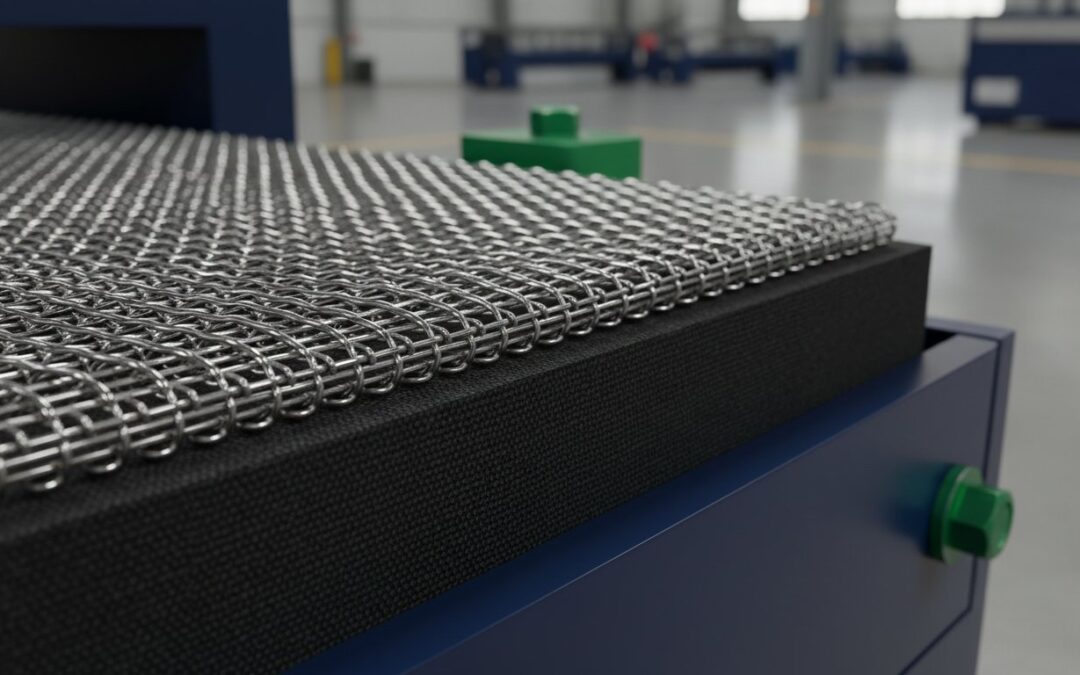
For sub-100 micron sifting, a single layer of fine wire cloth lacks the structural rigidity to resist sagging. Compass Wire Cloth utilizes a 2-mesh or 4-mesh backing cloth to provide a stable foundation for these delicate layers. This coarser mesh supports the top sifting layer without significantly reducing the open area, which is critical for maintaining high flow rates. Proper selection of backing mesh prevents blinding by keeping the wire geometry stable under the weight of the material. If the support is insufficient, the fine mesh stretches, altering the aperture size and leading to off-spec product.
Edge Reinforcements for Hooked and Pre-Tensioned Screens
Choosing between metal and synthetic edging depends on the specific chemical exposure and operating temperatures of your facility. Precision-folded hooks are essential for achieving uniform tension across the entire screen surface. We reinforce the “V” or “U” hook with additional metal liners to prevent slippage, a common cause of wire fatigue in high-vibration environments. Innovation in this field, such as the designs detailed in this externally reinforced screen panel patent, highlights the industry’s shift toward specialized structural supports for heavy-duty mining and quarrying applications.
Beyond the edges, center strips and impact areas protect the screen where the initial material drop occurs. Using a 10-gauge or 12-gauge steel strip at the point of impact absorbs the kinetic energy of falling aggregate, preventing localized tearing. This targeted reinforcement ensures the screen doesn’t fail at its most vulnerable point.
Encapsulated edges offer another layer of protection by utilizing high-grade polymers to lock wires into place. This process prevents wire migration and fraying, which often extends the screen’s operational life by 30% in abrasive conditions. These polymers create a seal that resists moisture and chemical corrosion, protecting the wire ends from degradation. If you need assistance selecting the right configuration for your specific machinery, you can consult with an expert at Compass Wire Cloth to determine the best reinforcement strategy for your production goals.
Material Selection: Alloys and Synthetics for Maximum Durability
Selecting the correct substrate for screen reinforcements determines the operational lifespan of a filtration system. Material choice isn’t just about cost; it’s about matching the physical properties of the wire or fiber to the specific stresses of the application. Compass Wire Cloth utilizes a range of high-performance materials to ensure every assembly meets rigorous industrial standards.
- Stainless Steel 304 and 316: These alloys are the primary choice for most industrial environments. Type 304 provides a baseline tensile strength of 75,000 psi, while Type 316 adds molybdenum to resist chloride-induced pitting.
- High-tensile carbon steel: For applications involving heavy aggregates or abrasive minerals, oil-tempered carbon steel is superior. It offers a Rockwell C hardness between 45 and 50, providing the grit needed to withstand constant friction.
- Synthetic mesh reinforcements: Polyester and nylon are critical for chemical sifting where metallic alloys might react. Polyester maintains dimensional stability even with a 3% moisture absorption rate, making it ideal for wet processing.
- Polyurethane and rubber coatings: When screening heavy stone or ore, a polyurethane coating with an 85 Shore A durometer rating acts as a shock absorber. This protects the underlying mesh from the kinetic energy of falling material.
Engineering Tensile Strength for Heavy Loads
The yield strength of a wire alloy dictates how well screen reinforcements handle constant vibration without deforming. While 304 stainless steel is robust, its yield strength can drop if the sifter operates at temperatures exceeding 800°F. Precision heat treatment, such as stress-relieving or tempering, increases the fatigue life of reinforced sifter screens by up to 25% compared to untreated cold-drawn wire. Type 316 stainless steel is the preferred choice for FDA-compliant reinforcements because its 2% to 3% molybdenum content prevents pitting and crevice corrosion in harsh sanitary environments. This ensures the structural integrity of the screen remains uncompromised during high-frequency oscillation.
Chemical and Thermal Resistance Factors
High-heat applications in chemical processing require reinforcements that won’t oxidize or lose tension. In environments reaching 1,500°F, specialized nickel-based alloys are necessary to prevent catastrophic screen failure. Engineers must also account for galvanic corrosion, which occurs when dissimilar metals, such as a stainless mesh and a carbon steel frame, touch in the presence of an electrolyte. Utilizing synthetic reinforcements like nylon 6/6 provides a solution for alkaline environments with a pH above 9.0 where certain metals might degrade. These synthetics offer a lightweight alternative that resists caustic cleaning agents and maintains aperture precision over long production cycles. Our technical team guides you through these variables to ensure your screen reinforcements are optimized for your specific chemical and thermal profile.
Strategic Application: Optimizing Throughput and Longevity
Engineering a screening solution requires balancing structural integrity with processing speed. Implementing screen reinforcements is a calculated trade-off between the lifespan of the wire cloth and the effective open area of the deck. Precision matters here. When you add a support grid or backing wire, you reduce the percentage of open area. For example, a standard 20-mesh T304 stainless steel cloth might offer 50% open area, but adding a heavy-duty reinforcement layer can drop this to 42%. Our engineers ensure these layers align to minimize interference and maintain high flow rates.
In the aggregate sector, a Pennsylvania-based quarry increased screen life by 280% by switching to a customized reinforcement pattern on their primary vibrating decks. Conversely, in pharmaceutical applications, the ROI of screen reinforcements isn’t just about longevity; it’s about preventing wire fatigue that leads to batch contamination. A single 0.5mm wire break can ruin a $50,000 production run. By reinforcing the mesh, manufacturers gain peace of mind and protect their bottom line.
Balancing Durability with Sifting Efficiency
Over-reinforcing creates its own set of technical failures. Excessive backing increases the total mass of the screen, which requires higher energy consumption from the vibrating motor to achieve the same G-force. It also introduces blinding risks where fines become trapped between the primary mesh and the reinforcement layer. We recommend using high-tensile alloys to provide strength with a smaller footprint. Tapered reinforcement patterns are particularly effective. By placing heavier support at the feed end where impact is highest and thinning it out toward the discharge end, you maintain throughput without sacrificing structural integrity.
Installation Best Practices for Reinforced Hardware
Proper installation is the final step in securing your ROI. Failure to align hardware correctly negates the benefits of high-performance materials. Follow these technical standards:
- Center Strip Alignment: Center strips must align perfectly with the machine’s support bars. A 5mm misalignment causes the mesh to flex over the bar, leading to rapid fatigue failure.
- Torque Specifications: For reinforced hooked screens, follow specific torque settings. Over-tensioning stretches the wire beyond its elastic limit, while under-tensioning allows the screen to whip against the support frame.
- Support Bar Protection: Use heavy-duty rubber or polyurethane capping on all support bars to prevent metal-on-metal friction.
Ready to improve your deck’s performance? Consult with our technical team to design a reinforcement strategy that maximizes your uptime.
Compass Wire Cloth: Precision Engineering for Industrial Screens
Reliability in industrial screening starts with rigorous standards. We maintain an ISO 9001:2015 certified manufacturing facility, ensuring every screen reinforcement we produce meets exact tolerances and performance benchmarks. To support these high-level quality requirements in industrial fabrication, many plants rely on digital tools like socweld.com to automate their technical documentation. Choosing American-made reinforcements eliminates the logistical risks of international shipping, and it provides a level of quality control that overseas competitors cannot match. Our production floor utilizes advanced weaving and fabrication technology to deliver components that withstand extreme mechanical stress and high-volume throughput. We don’t just supply mesh; we engineer solutions that prevent premature failure in the field.
Our commitment to speed is a core pillar of our operations. We provide the fastest lead times in the industrial screening industry because we understand that a stalled production line is a financial liability. By keeping a vast inventory of raw wire and utilizing lean manufacturing principles, we turn complex orders around in days rather than months. This rapid response capability ensures your facility maintains peak efficiency without the need for excessive on-site inventory.
- ISO 9001:2015 Certification: Guarantees consistent quality and traceability for every component.
- Domestic Manufacturing: 100% American-made products for superior supply chain security and reliability.
- Advanced Metallurgy: Selection of high-performance alloys designed for specific tensile strength and corrosion requirements.
- Rapid Turnaround: Optimized workflows that deliver custom solutions faster than any other provider in the sector.
Custom Fabrication for Unique Industrial Challenges
Standard solutions rarely satisfy high-performance requirements. Our engineers collaborate directly with your team to design site-specific screen reinforcements that address your machinery’s unique vibration and load profiles. We specialize in the prototyping and rapid production of custom hooked and pre-tensioned screens tailored to your exact specifications. Think of our name as more than just a brand; it’s a technical compass guiding you toward the most efficient screening direction. We ensure your alloy selection, aperture size, and mesh configuration align perfectly with your material processing goals. Whether you’re handling abrasive minerals or fine chemicals, our tailored approach eliminates the guesswork.
Ready to Extend Your Screen Life?
Engineered reinforcements are the most cost-effective way to reduce screen failure and increase throughput. By selecting the right backing and edge treatments, you can extend the operational lifespan of your mesh significantly in abrasive applications. Our technical experts are ready to audit your current screening process and recommend upgrades that maximize durability. Don’t settle for off-the-shelf components that compromise your output and lead to frequent maintenance stops.
Contact Compass Wire Cloth for a Custom Reinforcement Quote to start your technical consultation today and secure the precision your operation demands.
Optimize Your Production with Precision Engineering
Selecting the right structural support for your mesh isn’t just about durability; it’s about safeguarding your entire production line against unscheduled downtime. High-performance screening requires a strategic balance between material tensile strength and open area to maintain maximum throughput. Whether you’re utilizing heavy-duty alloys or advanced synthetics, the precision of your hardware determines the longevity of your equipment. It’s essential to partner with a manufacturer that understands these technical specifications and the high-stakes nature of industrial processing.
Compass Wire Cloth delivers reliability through every weave. As an ISO 9001:2015 Certified Manufacturer, we maintain strict adherence to quality standards that guarantee performance in the field. We offer the fastest turnaround in the industry, ensuring your facility stays operational without long lead times. Our products represent the best in American-made quality, providing the technical mastery your operations require. Don’t settle for components that can’t handle the pressure of high-volume screening.
Request a Quote for Custom Screen Reinforcements today to secure the precision your facility deserves. We’re ready to help you navigate your most complex screening challenges with speed and accuracy.
Frequently Asked Questions
What are the most common types of screen reinforcements for vibratory machines?
The most common types include backing cloths, center support strips, and side-tensioning shrouds. We typically utilize a heavy-duty 2-mesh or 4-mesh backing cloth to provide structural support for fine meshes that operate under high centrifugal force. This configuration prevents the primary mesh from stretching or sagging during 24/7 production cycles.
Does adding a backing cloth significantly reduce my sifting throughput?
Adding a backing cloth typically reduces sifting throughput by 10% to 15% depending on the wire diameter used. While there’s a slight loss in open area, the trade-off is a significant reduction in downtime caused by mesh fatigue. You’ll find that the increased uptime far outweighs the minor decrease in flow rate for most high-volume applications.
Can I reinforce an existing screen, or must I order a custom-fabricated one?
You must order a custom-fabricated screen because effective screen reinforcements require factory-grade bonding and precision tensioning. Attempting to add support to an existing screen in the field often results in uneven tension, which causes the mesh to fail within hours. We manufacture custom solutions that integrate the reinforcement directly into the hook or frame for maximum durability.
Which material is best for reinforcements in high-heat industrial applications?
316L Stainless Steel is the superior material for reinforcements in environments reaching up to 800 degrees Fahrenheit. For extreme thermal processing exceeding 1,200 degrees, we utilize specialized alloys like Inconel 600. These materials prevent the mesh from oxidizing or losing its tensile strength during continuous high-heat exposure.
How do I know if my screen failure is due to lack of reinforcement or improper tensioning?
Screen failure caused by lack of reinforcement typically manifests as center-screen tearing or ballooning under the weight of the material load. If the failure is due to improper tensioning, you’ll see fraying at the hooks or circular wear patterns near the motor mounts within the first 24 hours of use. Checking the tension with a digital gauge can confirm if the screen meets the manufacturer’s recommended 30 to 40 Newton-meters.
Are reinforced screens compatible with FDA-compliant food processing standards?
Yes, our reinforced screens are fully compatible with FDA-compliant food processing standards. We use 304 or 316 grade stainless steel and food-grade adhesives that comply with FDA Title 21 CFR 177.2600. This ensures your production line maintains hygiene standards while benefiting from the added strength of our precision-engineered designs.
What is the typical lifespan increase when using reinforced hooked screens?
Using reinforced hooked screens typically increases the component’s lifespan by 300% compared to standard single-layer mesh. In abrasive mining or aggregate applications, a standard screen might only last 150 hours. By adding a high-tensile backing cloth, that same screen often reaches 600 hours of continuous operation before requiring replacement.
How does Compass Wire Cloth ensure rapid turnaround for custom-reinforced orders?
Compass Wire Cloth ensures rapid turnaround by maintaining a massive inventory of over 100 mesh types in our domestic facility. We ship most orders featuring custom screen reinforcements within 24 to 48 hours. Our streamlined manufacturing process allows us to provide the fastest response times in the industry, keeping your production lines moving without long lead times.