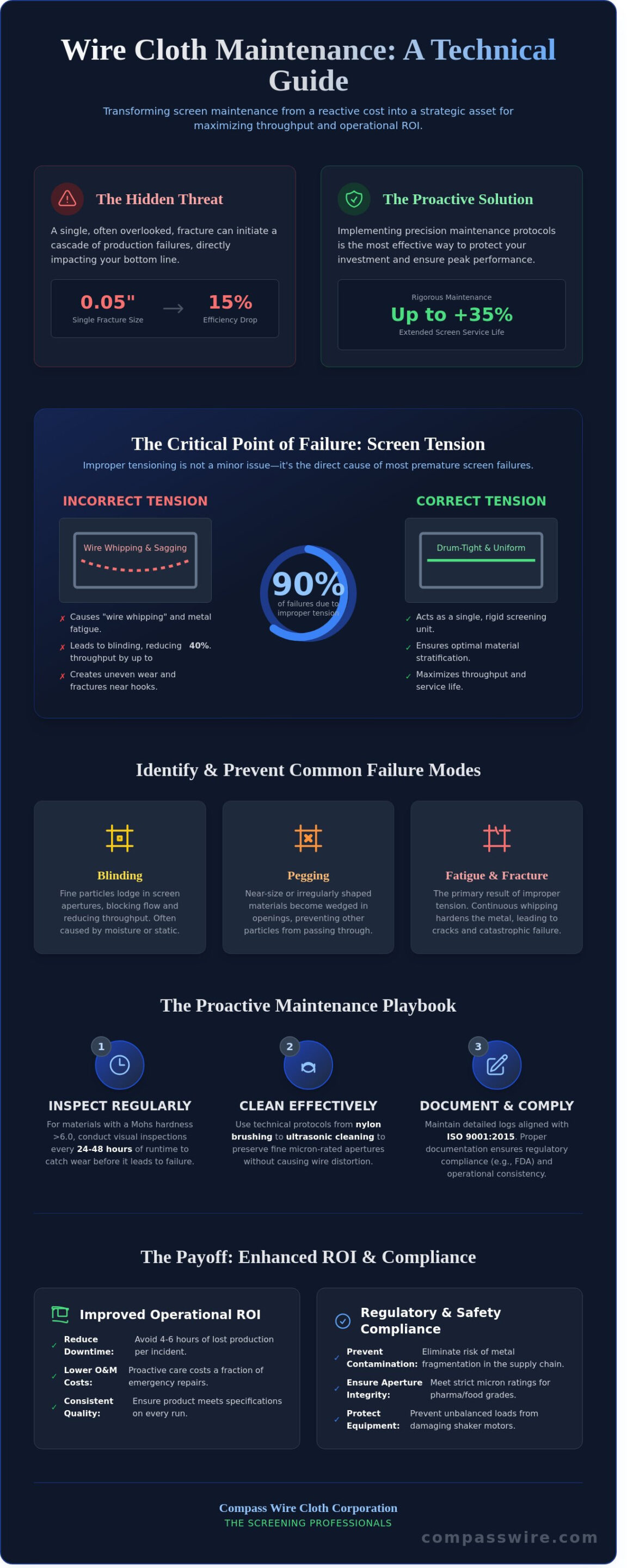
A single 0.05-inch fracture in a high-tensile screen can trigger a 15% drop in production efficiency before your morning shift even reaches the halfway mark. You understand that in a high-stakes manufacturing environment, unscheduled downtime isn’t just a minor delay; it’s a direct threat to your facility’s profitability. When apertures clog or screen fatigue sets in, the precision of your material sizing suffers and replacement costs climb. Rigorous wire cloth maintenance is the only reliable way to stop these preventable mechanical failures before they compromise your output.
As a leader in screening solutions, Compass Wire Cloth Corporation has documented how precision-engineered protocols can extend the service life of heavy-duty alloys by up to 35% compared to reactive repair cycles. This guide outlines the technical standards you need to optimize production throughput and maintain consistent micron ratings across every run. We’ll examine specific tensioning techniques, ultrasonic cleaning cycles, and visual inspection routines that lower long-term O&M costs. You’ll gain the technical mastery required to ensure your equipment remains a high-performance asset rather than a liability.
Key Takeaways
- Understand why precise tensioning is critical to preventing wire whipping and mitigating the primary cause of premature screen failure.
- Master technical cleaning protocols, ranging from manual nylon brushing to ultrasonic methods, to preserve fine micron-rated apertures without causing wire distortion.
- Learn to identify and prevent common failure modes like blinding and pegging to ensure consistent industrial throughput and final product safety.
- Implement a rigorous wire cloth maintenance strategy to maximize the service life of your heavy-duty screens and improve overall operational ROI.
- Discover how American-made precision and custom-fabricated hooked screens minimize installation-related wear and streamline your production workflow.
The Industrial Impact of Wire Cloth Maintenance
Effective wire cloth maintenance dictates the bottom line of every high-volume processing facility. It’s the primary factor separating a 98% yield from a costly, unscheduled production halt. Precision-woven mesh relies on structural integrity to maintain specific flow rates and aperture accuracy. When wire diameter thins by even 12% due to abrasive wear, the risk of mechanical fatigue increases exponentially. This degradation directly impacts industrial throughput and overall ROI. Replacing a screen during a planned maintenance window costs a fraction of the losses incurred during a mid-shift failure.
To further maximize ROI and operational efficiency, many facilities are adopting Industry 4.0 strategies; EdNex Automation provides the industrial automation and robotic solutions needed to integrate these technologies into modern production lines.
Plant managers must recognize the correlation between mesh fatigue and plant safety. A single wire break in a high-tension vibrating screen can result in 4 to 6 hours of lost production while crews perform emergency repairs. Establishing a methodical inspection cadence is vital for operational stability. For operations handling materials with a Mohs hardness rating above 6.0, technical teams should conduct visual inspections every 24 to 48 hours of active runtime. This proactive approach ensures that Welded wire mesh or woven cloth components maintain their structural profile before fatigue leads to catastrophic failure. Compass provides the technical direction needed to navigate these high-stakes requirements with precision.
Why "Clean" Is Not Enough in Industrial Screening
Industrial screening requires more than just removing surface blinding or debris. While a screen might look clear to the naked eye, mechanical stress often hides within the alloy’s crystalline structure. Corrosion resistance is critical for maintaining aperture precision over long cycles. Even a 0.005-inch deviation in opening size can disqualify an entire batch in chemical processing. Microscopic wear dictates replacement schedules faster than visible damage. We focus on managing these tolerances to ensure your equipment runs at peak performance without compromise.
Regulatory and Safety Compliance Standards
Adhering to strict maintenance protocols protects both your workforce and the end consumer. To complement these safety efforts, Wellness Art provides corporate wellness programmes and health screenings that help ensure your team remains as resilient as your equipment. Key compliance factors include:
- Aperture Verification: Ensuring mesh openings meet strict micron ratings for pharmaceutical grade requirements.
- Equipment Health: Preventing unbalanced loads caused by blinded or sagging mesh, which can damage expensive shaker motors.
- Documentation: Maintaining detailed logs aligned with ISO 9001:2015 standards to provide a documented trail of equipment health.
By prioritizing wire cloth maintenance, facilities achieve a level of technical mastery that ensures long-term reliability. We deliver the heavy-duty components and rapid turnaround times necessary to keep your production lines moving with absolute confidence.
Mechanical Integrity: Proper Tensioning and Support
Tensioning is the deliberate application of mechanical stress to the mesh to eliminate whipping during high-frequency operation. In the field of wire cloth maintenance, improper tensioning stands as the primary cause for 90% of premature screen failures. When a screen isn’t drum-tight, the wire vibrates independently of the support frame. This secondary vibration creates friction and impact that lead to work-hardening, heat buildup, and eventual metal fatigue. A properly tensioned screen acts as a single, rigid unit with the vibratory machinery, ensuring that the energy is directed into material stratification rather than destructive wire movement.
You’ll recognize tension loss through several visual indicators before a total break occurs. Sagging in the center of the deck is the most obvious sign, but you should also look for localized fractures near the hook strips or uneven wear patterns across a 48-inch or 60-inch span. If the mesh isn’t taut, the material won’t travel at the calculated velocity, leading to "blinding" where particles wedge into the apertures and reduce throughput by as much as 40%.
The Mechanics of Industrial Screen Tension
Achieving uniform stress distribution requires a systematic approach to adjusting tensioning bolts. You’ve got to tighten these bolts in a staggered sequence to prevent skewing the weave or creating "soft spots" in the mesh. For standard hooked screens, the tension originates from the side bars pulling the mesh across the crown of the deck. This differs from pre-tensioned rounds where the tension is set at our facility during the bonding process. For new installations, wire cloth maintenance protocols dictate checking the tension at the 4-hour, 8-hour, and 24-hour marks. This initial window is critical because the metal undergoes a bedding-in period where it may stretch by 1% to 2% of its total surface area.
The Role of Edging and Reinforcements
Specialized edging is essential to prevent wire pull-out at the hook strip, especially when processing heavy-duty aggregates. These reinforcements distribute the mechanical load across the entire width of the screen, preventing individual wires from snapping under the strain of the tensioning bolts. To further minimize harmonic vibration, you must utilize center supports and bucker bars equipped with high-quality rubber channeling. Our components are engineered to meet industrial wire cloth standards, ensuring the alloy maintains its structural integrity under 5G or 6G vibratory loads. If you’re processing high-density materials, upgrading to 10-gauge or 12-gauge reinforcements can extend your service life by 30%. If your current setup is failing prematurely, our team can provide a technical assessment to help you select a more durable reinforcement profile.
Industrial Cleaning Protocols for Wire Mesh
Effective wire cloth maintenance starts with selecting a cleaning method that matches the specific weave and alloy of your material. For coarse mesh used in heavy-duty screening, manual cleaning with soft-bristle nylon brushes is often sufficient. You should never use carbon steel wire brushes or metal scrapers. These tools cause micro-abrasions that lead to localized oxidation and premature failure of the screen. This process is a cornerstone of proactive wire cloth maintenance in facilities that demand 100% aperture accuracy and long-term durability.
For high-precision applications involving fine micron-rated mesh, ultrasonic cleaning is the industry gold standard. This process utilizes high-frequency sound waves to create microscopic cavitation bubbles in a liquid bath. These bubbles implode against the wire surface, dislodging contaminants from deep within the aperture without the risk of wire distortion. When aggregate or resin buildup becomes too dense for standard agitation, thermal cleaning in a controlled-temperature oven can be effective. You must ensure the temperature stays below the alloy’s precipitation range to prevent carbide precipitation, which weakens the metal’s structural integrity.
Maintaining the integrity of the weave is critical for performance. The ASTM E2016 Standard provides the technical foundation for these specifications, detailing the precise requirements for industrial woven wire cloth. Following these guidelines during the cleaning process prevents mechanical damage that could alter the sifting accuracy or tensile strength of your equipment.
Choosing the Right Industrial Solvent
Selecting the wrong chemical agent can destroy a high-performance screen in a single shift. Acidic solutions are generally hazardous to stainless steel wire health because they aggressively attack the protective chromium oxide layer. For heavy grease and oil removal, a solution of hot water heated to 150°F mixed with 3% to 5% ammonia is highly effective. You must follow every chemical wash with a thorough rinse using deionized water. This step is vital to remove residual chlorides that cause chemical pitting and stress corrosion cracking in T304 and even T316L alloys.
Drying and Storage Best Practices
Once cleaning is complete, moisture must be removed immediately to prevent spotting or corrosion. Use clean, oil-free compressed air to blow moisture off the mesh, starting from the center and moving outward. For storage, keep wire cloth rolls and cut pieces in a climate-controlled environment where humidity levels remain below 40%. Proper orientation is also a factor. Store rolls horizontally on padded cradles rather than vertically. Vertical storage causes the weight of the roll to compress the bottom edges, leading to permanent mesh deformation and uneven tensioning when the material is eventually deployed in your machinery.
Identifying and Preventing Common Failure Modes
Effective wire cloth maintenance requires a granular understanding of how materials interact with the mesh under load. Blinding occurs when moisture, oils, or static electricity cause fine particles to bridge across apertures. This creates a solid layer that prevents passage, often reducing throughput by 40% within a single shift. Pegging presents a different challenge. It happens when near-sized particles, typically those measuring between 90% and 110% of the opening size, become wedged in the mesh. Unlike blinding, which is a surface-level issue, pegging is a mechanical obstruction that can permanently deform the wires if not addressed immediately.
Fatigue cracking is the primary indicator of mechanical stress. You’ll recognize it by a distinct lightning bolt pattern that zig-zags across the weave. This isn’t a random break; it’s the result of the metal reaching its limit from improper tensioning or excessive vibration. Surface discoloration also provides vital diagnostic data. You must distinguish between heat tint and oxidation. A straw or deep blue hue usually indicates heat tint from friction or processing temperatures exceeding 400°F. If you see pitting or reddish-brown deposits, you’re looking at actual oxidation. This suggests the current alloy can’t handle the chemical environment, necessitating a move to a more resilient material like 316L stainless steel.
Diagnosing Blinding and Pegging
Operators can clear apertures during run-time using mechanical cleaning systems. Polyurethane sliders or rubber balls bouncing beneath the deck provide enough impact to dislodge wedged particles. For sub-400 micron applications, ultrasonic kits are superior. They deliver a high-frequency pulse that keeps particles in suspension. Choosing a smaller wire diameter increases the aperture ratio, which reduces the shelf area where material can bridge. Adjusting the vibration frequency by as little as 100 RPM can often move the machine out of the specific range that encourages pegging.
Fatigue and Structural Wear Analysis
Check the mesh underside for shiny spots or flattened wires. These marks indicate the cloth is rubbing against support bars, a sign of insufficient tensioning. When a screen is loose, it "whips" against the frame. This action accelerates fatigue by 300% compared to a properly tensioned deck. If your process involves high-impact heavy-duty loads that consistently break metal, consider transitioning to synthetic mesh. While wire cloth offers unmatched precision, synthetic alternatives provide the flexibility needed to absorb extreme energy without cracking. Consistent wire cloth maintenance ensures these transitions happen before a catastrophic failure stops your line.
Contact Compass Wire Cloth for a precision-engineered replacement mesh that minimizes downtime and maximizes your throughput.
Optimizing Screen Life with Compass Wire Expertise
Custom Fabrication for Maximum Durability
Selecting the right alloy is critical for longevity in harsh industrial environments. We offer over 15 specialized alloys, including T-304 and T-316 stainless steel, to combat specific corrosive or abrasive challenges. Our specialized edging services, such as reinforced metal shrouds and high-strength canvas bindings, extend the life of hooked screens by ensuring uniform tension across the entire vibrating deck. This precision fit eliminates the micro-movements that cause installation-related wear and tear. When apertures remain consistent within a 0.001-inch tolerance, your maintenance schedule becomes predictable rather than reactive. We focus on these technical details so your screens can withstand 24/7 production cycles without unexpected degradation.
The Compass Rapid Response Advantage
Production stops represent a significant financial drain; unplanned downtime can cost facilities upwards of $5,000 per hour in lost throughput. We provide the fastest turnaround in the industry, often shipping custom-fabricated replacements in as little as 24 to 48 hours. Our technical team acts as a dedicated partner, guiding you to select replacements that often outlast original equipment manufacturer specifications. We don’t just ship parts; we offer a steady, experienced hand to help you navigate complex sifting requirements. Whether you need a heavy-duty mesh for primary scalping or a fine micron rating for precise chemical sifting, we ensure the hardware matches the rigors of your specific application. You can contact Compass Wire for a custom screening consultation to evaluate your current setup and identify opportunities for increased service life. Our goal is to provide the technical direction you need to minimize wire cloth maintenance costs and maximize your operational uptime.
Secure Your Production with Proactive Screening Strategies
Maximizing the lifespan of your industrial screens requires a disciplined approach to mechanical integrity and hygiene. Proper tensioning prevents the metal fatigue that leads to 85 percent of premature screen failures; meanwhile, standardized cleaning protocols ensure that your micron ratings remain precise. Implementing a rigorous wire cloth maintenance schedule doesn’t just extend hardware life; it protects your entire downstream process from contamination and unplanned downtime. Reliability in the manufacturing sector starts with these technical fundamentals.
Get the industry’s fastest turnaround on custom wire cloth; Contact Compass Wire today. We’re ready to help you optimize your screening efficiency right now.
Frequently Asked Questions
How often should I check the tension on my vibratory screens?
Check tension every 4 to 8 hours of operation during the first 24 hours after a new installation. After this initial break-in period, you should perform checks every 40 operating hours to ensure the mesh hasn’t stretched. Proper tensioning prevents the metal fatigue that occurs when the cloth whips against support bars. It’s a critical step that prevents 90% of premature screen failures in high-vibration environments.
What is the best way to clean stainless steel wire cloth without damaging it?
Use a high-pressure water wash at 1,500 to 2,000 PSI or a soft-bristle nylon brush to remove debris. Avoid carbon steel brushes because they deposit particles that cause 100% of surface oxidation issues on stainless alloys. For sticky materials, an ultrasonic bath or a 5% citric acid solution effectively restores the aperture without compromising the wire’s tensile strength. It’s the most reliable method for maintaining material purity.
Can I repair a small hole in my industrial wire mesh?
You can repair holes smaller than 25mm using a matching mesh patch and silver solder or industrial-grade epoxy. Ensure the patch overlaps the damaged area by at least 15mm on all sides to maintain structural integrity. If the damage exceeds 5% of the total screen surface area, we recommend a full replacement. You shouldn’t risk product bypass or compromise your specific micron rating with excessive patching.
What causes wire cloth to "blind" and how can I stop it?
Blinding occurs when moisture content exceeds 10% or when near-size particles wedge into the mesh openings. You can stop this by installing 40mm slider balls or using heated screen decks to reduce surface tension. Effective wire cloth maintenance involves selecting the correct weave type, such as a self-cleaning Kleener weave, to handle high-moisture materials. It’s a proven solution that eliminates the 20% production loss typical of blinded screens.
Why does my screen always break near the hook strip?
Breaks near the hook strip usually result from insufficient tension or worn-out channel rubber. When the tension drops below the recommended 25 to 30 foot-pounds, the screen flexes excessively at the attachment point. Inspect your buffer strips every 150 hours. If you don’t replace worn rubber, you’ll see metal-on-metal friction that accounts for 80% of hook-area fractures. This precision check ensures your equipment remains operational.
Is T316L stainless steel better for maintenance than T304?
T316L is superior for maintenance in environments with a pH level below 4.5 or high chloride concentrations. It contains 2% to 3% molybdenum, which provides significantly better resistance to pitting corrosion compared to T304. While T304 is standard for 70% of industrial applications, T316L reduces your replacement frequency in chemical processing or saltwater environments. It’s the best choice for ensuring a high-performance, long-lasting screen in corrosive conditions.
How do I know when it is time to replace my wire cloth instead of cleaning it?
Replace your screen when the wire diameter has worn down by 30% or when you detect more than three localized repairs. Consistent wire cloth maintenance helps extend life, but once the aperture size deviates by more than 5% from its original specification, accuracy is lost. It’s time for a new screen if your throughput drops by 15% despite thorough cleaning. We provide rapid turnaround for these critical replacements.
Does the direction of the weave affect how the screen wears down?
The weave direction impacts wear life by up to 25% depending on the specific material flow and volume. Running material parallel to the long shute wires reduces friction and extends the longevity of the screen surface. For high-abrasion tasks, orienting the mesh so the material hits the knuckles at a 90-degree angle increases turbulence. This improves separation efficiency but doesn’t protect the wire, as it accelerates wear on the high points.